
Edge Controller: Machine-Level Energy Monitoring
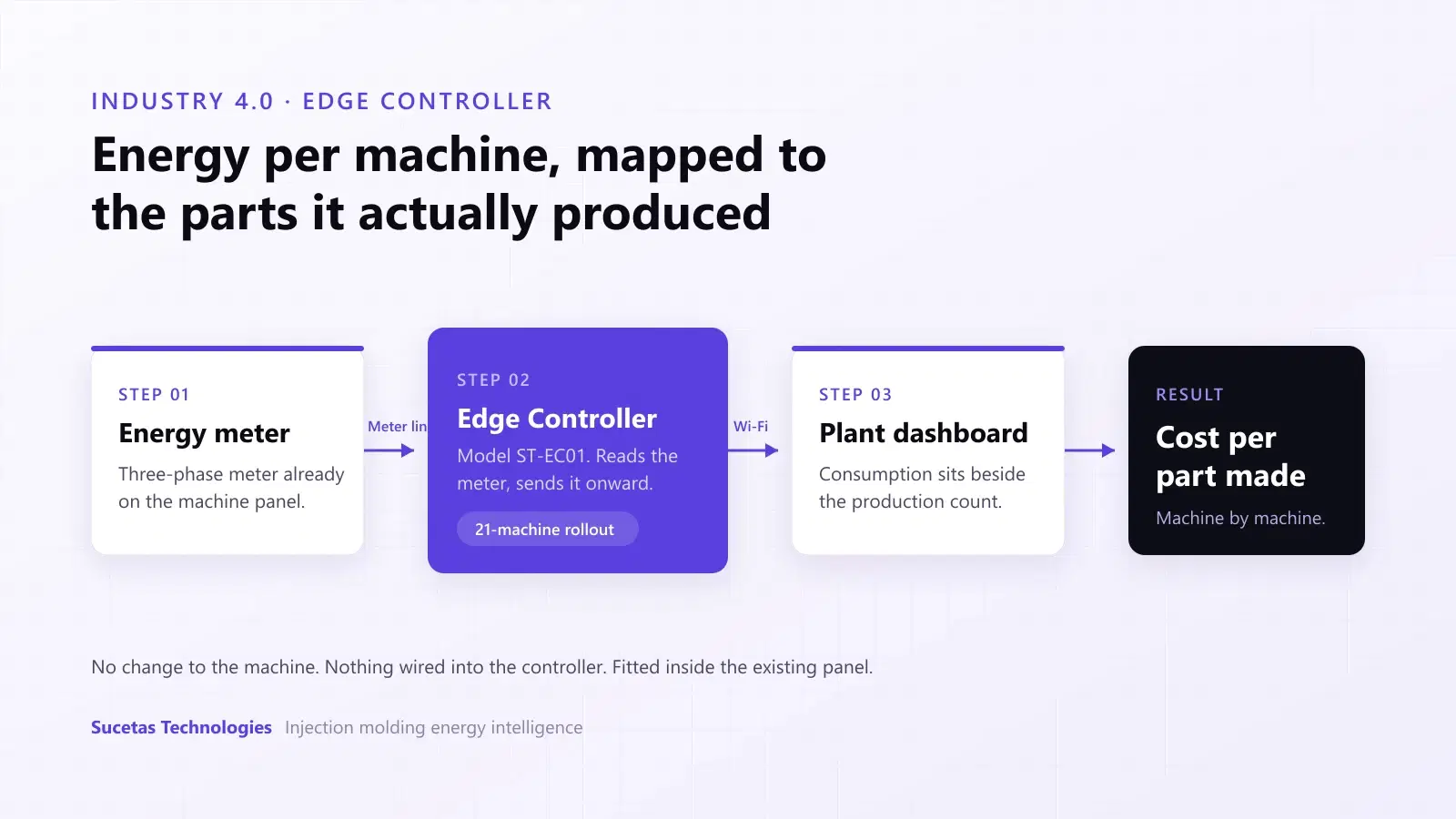
A small edge device in each machine's electrical panel, reporting how much electricity that machine draws, placed beside how many parts it produced. Twenty-one units, one plant, and a cost-per-part number that finally has a machine's name on it.
- Machines instrumented
- 21
- Device model
- ST-EC01
- Changes to the machine
- None
- Each unit
- Serialised and verifiable
The challenge
A molding plant receives one electricity bill for the whole site. Inside that bill sit machines of very different sizes, running different molds, at different cycle times, on different shifts, and no one can say which of them is expensive. When the bill rises, the plant has no way to tell whether a machine is drifting, whether a particular mold is costly to run, or whether a shift is simply leaving machines heating with nothing to do. Energy is one of the largest controllable costs on the floor, and it was the one number nobody could attribute.
What we built
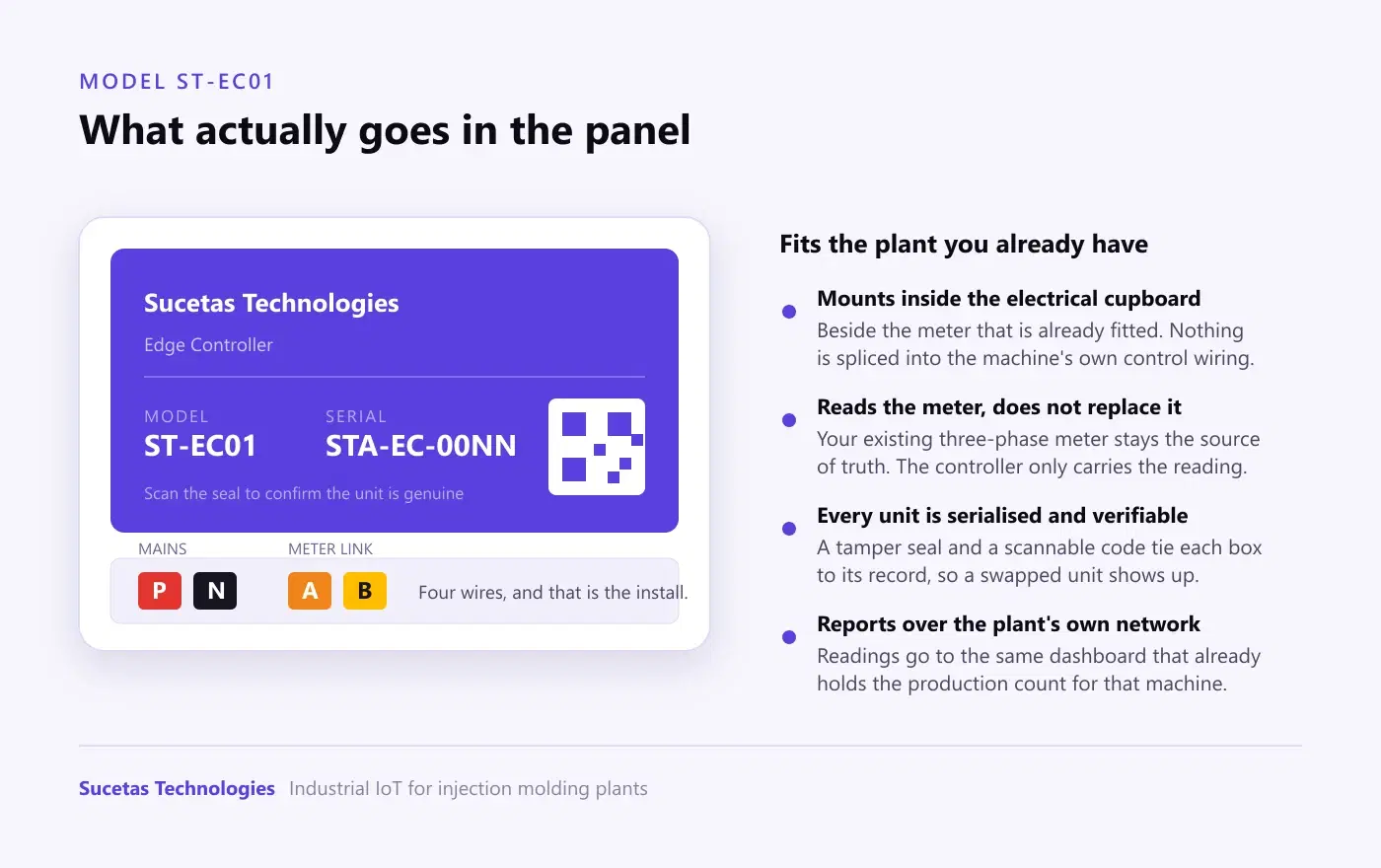
Sucetas designed and built the Edge Controller, model ST-EC01: a small serialised device that sits inside the machine's existing electrical cupboard, reads the energy meter already fitted there, and reports that reading onward over the plant's own network. Nothing is spliced into the machine's control wiring and the meter itself is not replaced. Because the reading arrives in the same system that already holds the production count for that machine, consumption stops being a site total and becomes a per-machine, per-mold, per-shift number that can be set against the parts actually made.
One bill, many machines, no attribution
Most plants know exactly what they paid for electricity last month and nothing at all about where it went. The meter at the gate is honest and useless: it is a single number covering a floor of machines that differ by tonnage, by mold, by cycle time and by how well they are running that week.
Without attribution there is nothing to act on. A machine that has quietly started drawing more than it should looks identical to one that is simply busy. A mold that is expensive to run looks identical to a cheap one. And a shift that leaves barrels heating through a long changeover leaves no trace at all.
A small device, in a place that already exists
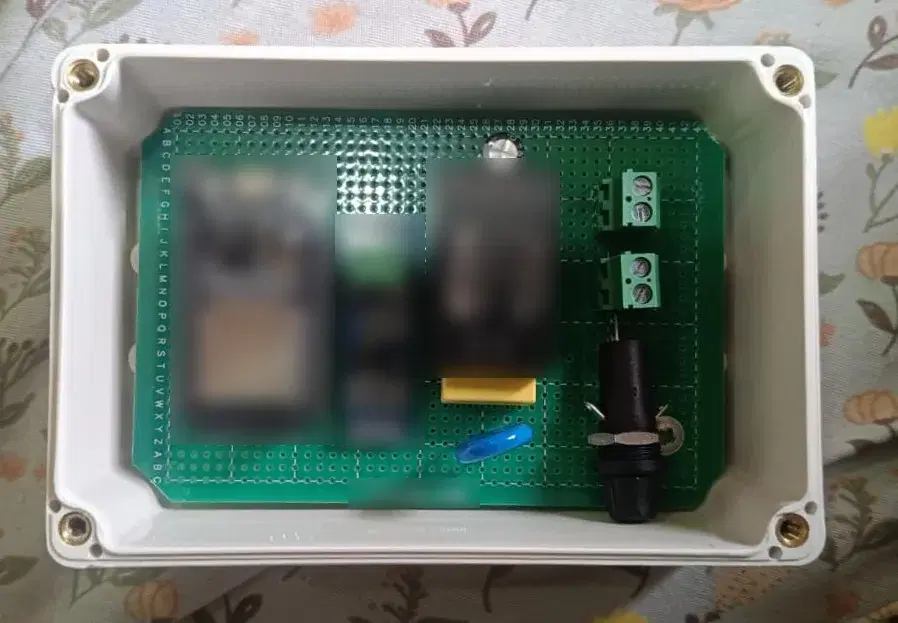
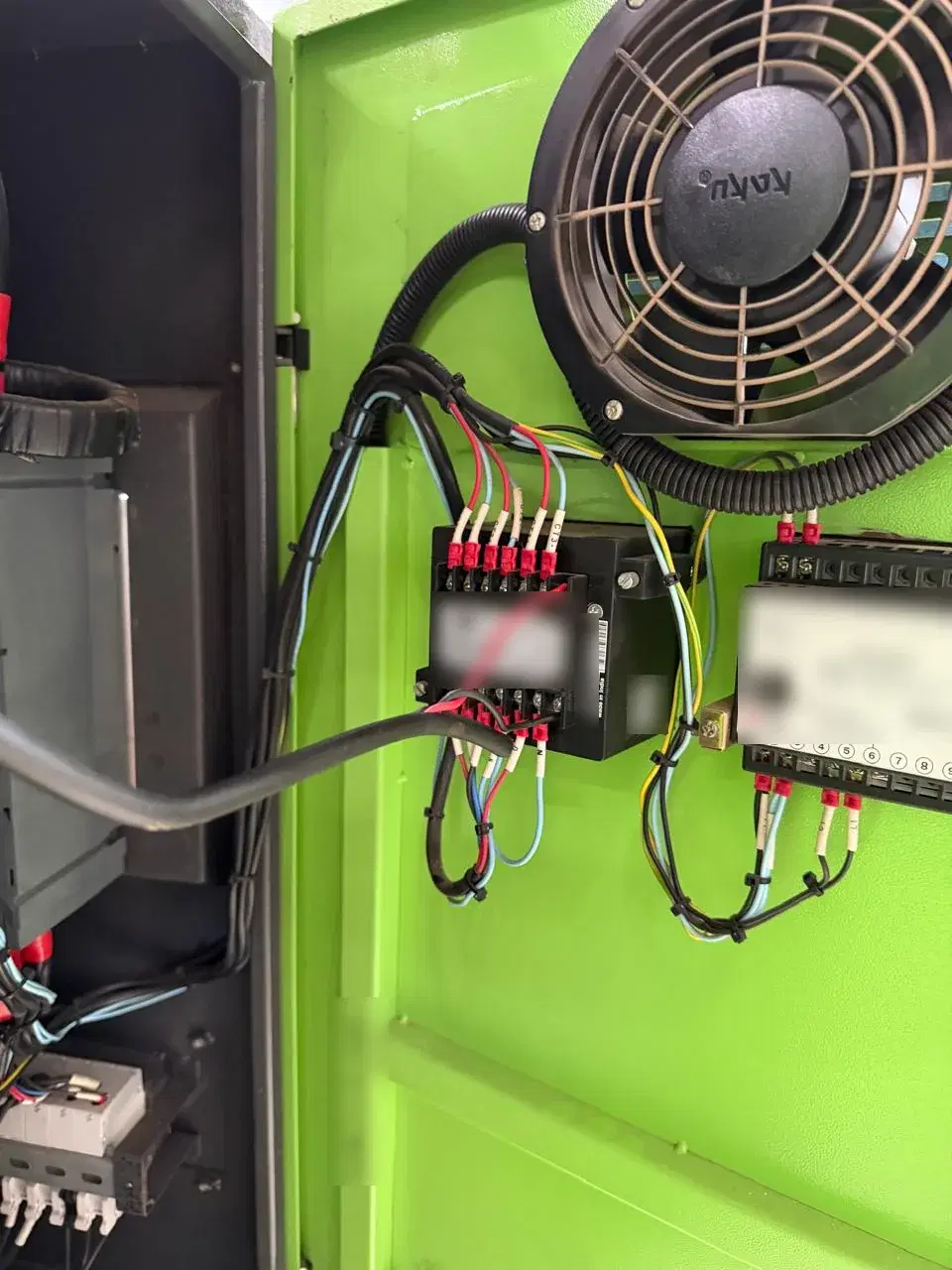
The Edge Controller was designed to be unremarkable to install. It mounts inside the electrical cupboard that is already on the machine, beside the energy meter that is already fitted there, and it takes four connections: two for power and two for the link to the meter.
It does not replace the meter and it does not touch the machine's own control wiring. The meter stays the source of truth. The controller's job is simply to carry that reading to the plant system, continuously, without anyone writing anything down.
- Fits inside the existing panel, so no new enclosure is added to the machine
- Four connections per unit, and that is the whole install
- The existing energy meter remains the measuring instrument
- Reports over the plant's own network, to the plant's own system
Energy sitting next to the part count
The point of the device is not the reading. It is where the reading lands. Because consumption arrives in the same platform that already knows how many good parts that machine produced in that hour, on that mold, in that shift, the two can be read together.
That turns a site-level cost into an operational one. Energy per part becomes a number you can compare between machines running the same mold, between shifts running the same machine, and between this month and last. It also makes the quiet losses visible: the machine that consumes at a normal rate while producing nothing is exactly the machine that never shows up on an electricity bill.
- Consumption per machine, per mold and per shift instead of per site
- Energy set against the parts the machine actually produced
- Comparison between machines running the same tool
- Consumption during downtime made visible rather than absorbed
Every unit is accounted for
Hardware that lives inside twenty-one different panels needs to be traceable, or a year later nobody knows which box is which, whether one has been swapped, or whether the unit in front of them is even ours.
Each Edge Controller carries its own serial number and a tamper seal, and each can be checked against our register by scanning the code on the unit. A genuine device returns its record. Anything else is reported as unrecognised.
Where this is now
The rollout covers twenty-one machines at Tech Arch Autocomp, on the same floor already monitored by our injection molding monitoring system. Units are built, serialised and being commissioned machine by machine.
We are deliberately not publishing savings figures yet. Energy claims are only worth anything once they rest on a full baseline against a measured period, and that comparison is still being collected. What the plant has today is attribution: a consumption figure with a machine's name on it, sitting next to that machine's output.
Inside the system
What it does
Measurement and attribution
- Electricity consumption tracked per machine rather than per site
- Consumption attributed to the mold running at the time
- Consumption attributed to the shift that was on
- Energy read against the good parts produced in the same period
- Consumption during downtime and changeover made visible
Installation and fit
- Mounts inside the machine's existing electrical cupboard
- Uses the energy meter already fitted, rather than replacing it
- No connection into the machine's own control wiring
- Four connections per unit
- Works alongside machines of different makes and ages
Hardware integrity
- Every unit individually serialised
- Tamper seal on each enclosure
- Scannable verification code tied to our device register
- Unrecognised codes reported as unrecognised, so a swap is visible
- Mains protection built into the unit
What changed
- Electricity consumption now attributable to an individual machine
- Energy readable against the parts that machine produced
- Consumption comparable between machines running the same mold
- Energy drawn during downtime and changeover made visible
- Every unit serialised, sealed and individually verifiable
- No modification to any machine on the floor
For the first time the electricity number has a machine's name on it. We can put consumption next to output and ask a useful question.
Common questions
Do you replace our energy meters?
No. The meter already on the machine stays the measuring instrument. The Edge Controller reads it and carries that reading onward.
Does anything get wired into the machine?
No. The unit sits inside the electrical cupboard beside the meter and takes four connections. Nothing is spliced into the machine's control wiring, so the machine's warranty and behaviour are untouched.
Do we need the production monitoring system as well?
The energy figure is useful on its own, but it becomes far more useful next to a production count. Where our injection molding monitoring system is already running, the two sit in the same place and energy per part follows directly.
How do we know a unit is genuine?
Every unit carries its own serial number, a tamper seal and a scannable code. Scanning the code checks it against our register and returns that unit's record, so a swapped or unrecognised box shows up immediately.
What savings should we expect?
We are not publishing a savings figure until we have a full baseline measured against a full comparison period on a live floor. What the system delivers today is attribution, which is the thing that has to exist before any saving can be claimed or verified.
Written for a business audience, so implementation detail is deliberately left out. Last reviewed 6 September 2026.
More of our work
SaaS
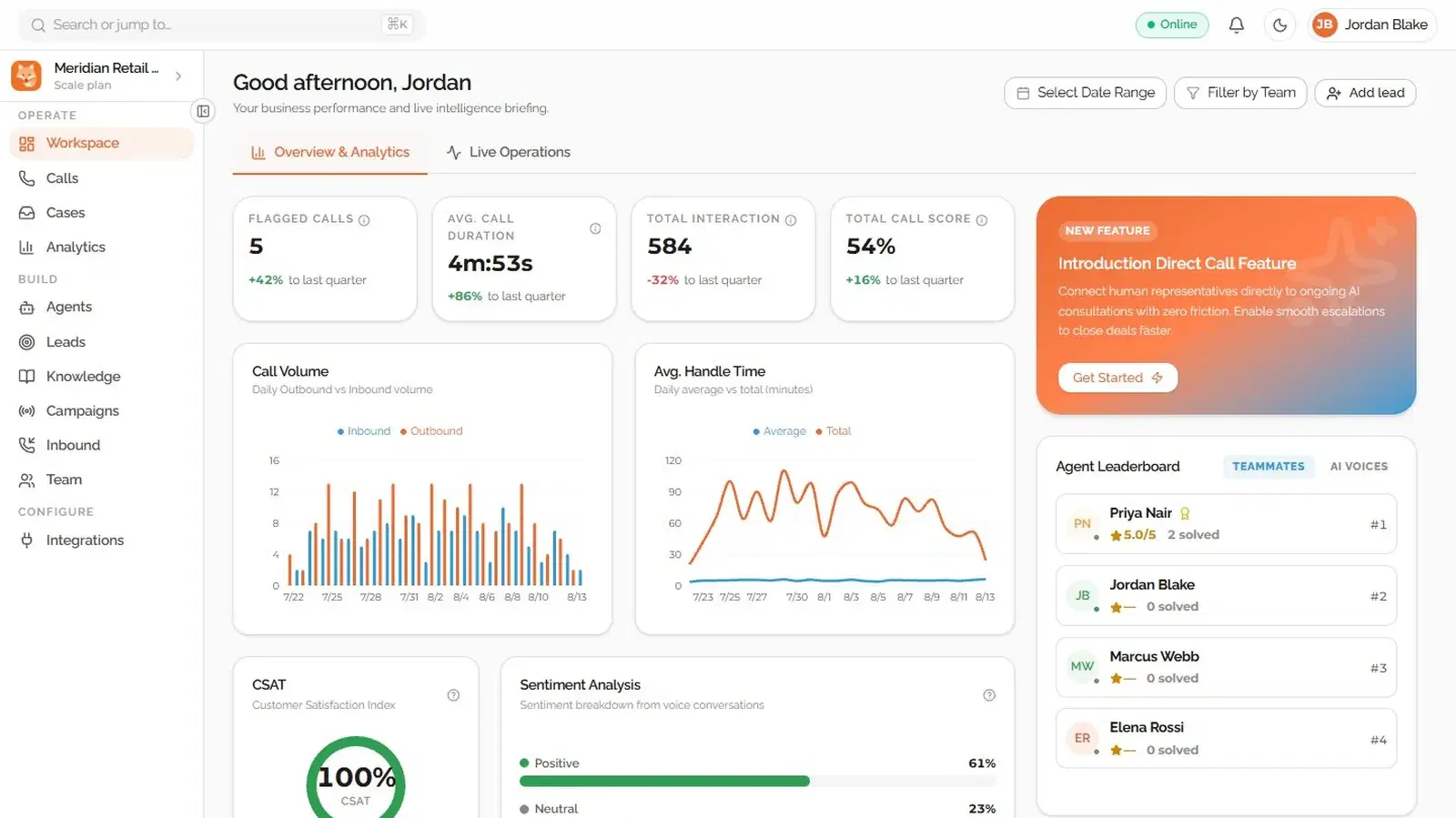
Dunefox: AI Customer Engagement Platform
Our own product, and the clearest demonstration of what we build. Dunefox brings support, leads and marketing into one AI-powered platform across web chat, WhatsApp, Instagram, Messenger and Telegram, now with AI voice agents that make and take phone calls.

Fashion & Apparel
Aeramide Luxury E-Commerce Platform
Aeramide is a premium fashion brand that wanted its online store to reflect the same elegance and attention to detail as its products. The challenge was not just building another e-commerce website, but creating a digital experience that felt luxurious, intuitive, and fast. The brand needed a platform where customers could explore collections effortlessly, while the internal team could manage products, inventory, promotions, and orders without technical complexity.

Education / Finance Training
Fintree Education Landing Platform
Fintree, a leading finance education institute specializing in CFA and FRM preparation, needed a modern high-conversion landing platform to introduce its programs and capture student inquiries efficiently. The existing online presence did not fully reflect the institute's reputation, teaching methodology, and global student base. The goal was to create a digital experience that clearly communicated the value of their programs while encouraging prospective students to explore courses and register for consultations.